Instruments, Instrumentation, and computational methods in mathematical astronomy
Digital Reconstruction as a Digital Bridge Over an Interdisciplinary Gap
Mathematics is indispensable to the study of the premodern astronomical corpus. As a historian of astronomy, I must analyze these texts and present my findings in ways that remain accessible to scholars in the humanities. This often requires visually translating mathematical models and procedures—ranging from spherics and spherical trigonometry for modeling celestial motions, time reckoning, and map projections, to the Euclidean geometry and arithmetic for planetary models and computational tables of planetary positions. Drawing on my dual training in medieval science and geomatics engineering, I use digital reconstruction to reimagine astronomical instruments and mathematical methods from textual evidence, creating a bridge between mathematical analysis and humanistic inquiry.
Revealing the latent mathematics in historical horoscopes
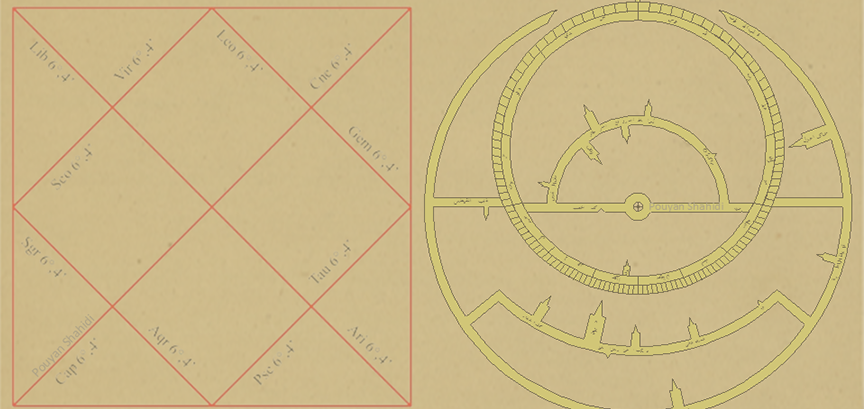
Horoscopes are astronomical diagrams that depict the position of the planets along the annual path of the sun in the sky for a given moment and location. The backbone of a horoscope is a twelve-part division of this path, each of which is called a cusp or astrological house. The historical cusp division methods are diverse and often mathematically complex. Detecting the astronomical-mathematical methods behind horoscopes is important in historical research especially to the historians of mathematics, and astronomy who are interested in tracing development and transmission of scientific knowledge across time and place. However, detecting those methods requires a substantial knowledge of mathematics. I bridge this gap with a digital reconstruction methodology. I developed a MATLAB (a software environment and programming language) program that enables researchers of humanities with little to no knowledge of mathematics to discover the underlying mathematical methods in historical horoscopes. This program reconstructs any historical horoscope through various medieval cusp calculation techniques, allowing users to identify the closest replicated model and thereby infer the most likely method used in the original chart.
The MATLAB program reconstructs the input horoscope cusps using various medieval calculation methods, then compares each reconstruction to the original cusps to identify the closest match and its method.
Crab-Shaped (Musarṭan) Astrolabe: Structure and Application Based on Critical Editions of 10th- and 14th-Century Treatises by Sijzī and Pīr Muḥammad Ḥakīm-i Tabrīzī
In the ninth and tenth centuries C.E., scholars in the Islamicate world combined the standard northern and southern planispheric astrolabes to create a new class of instruments now known in modern scholarship as mixed astrolabes. Among these, the crab-shaped (musarṭan) astrolabes are especially notable, though no specimens have survived to the present. While medieval astrolabe-making literature describes their geometric and astronomical structure, a group of treatises focused specifically on their operation.
In my master’s thesis, I critically edited and analyzed two such treatises preserved in unique Arabic and Persian manuscripts from the 10th and 14th centuries, written respectively by Abū Saʿīd Sijzī and Pīr Muḥammad Ḥakīm Tabrīzī. To replicate the operations they describe, I reconstructed the musarṭan astrolabes used by their authors. This required gathering specifications scattered throughout the texts, performing structural calculations in MATLAB, and modeling the instruments in AutoCAD. The result was both functional digital reconstructions and physical objects that illuminate the practical use of these remarkable instruments.
Demonstration of my digital reconstruction of a crab-shaped (musarṭan) astrolabe using MATLAB and AutoCAD.
Astrolabes at the Malek Museum (Tehran, Iran): From Collection Objects to Public Engagement
Astrolabes are medieval scientific instruments that mechanically model the positions of the stars, the sun, and the celestial sphere for a specific time and place. They function as multilayered, temporally dynamic maps of the sky, adjustable for different latitudes, and incorporate visual and mechanical tools for angle measurement, time reckoning, direction finding, and trigonometric calculation. Yet in modern Persian cultural memory, astrolabes are often known mainly through literary metaphors that cast them as exotic or occult objects. Fully understanding their structure and astro‑mathematical uses requires familiarity with premodern astronomy and spherical trigonometry, making them challenging to interpret for general audiences. In this project, I independently designed a process to address the challenges of studying and deciphering the Malek Museum’s astrolabe collection (Tehran, Iran), employing digital reconstruction methods. I then worked with the museum’s curatorial team as a consultant to translate this research into a public exhibition, making these scientific instruments accessible to Iranian audiences of all ages.
I conducted a detailed study of the six astrolabes in the collection, which range in date from the 13th to the 18th century, in order to describe and decipher them for audiences spanning the general public, students, and scholars. Based on this research, I produced an illustrated brochure that introduces the history and constituent parts of astrolabes and explains a range of their functions—from time reckoning and determining the direction of Mecca to performing remote measurements such as calculating the height of a tower or the width of a river.
I also published a catalogue of the collection as a book, introducing the history, mathematical and physical structure, functions, and different types of astrolabes. The catalogue provides research‑based, detailed descriptions of each instrument, presented part by part, and includes the transcription, translation, and interpretation of their inscriptions as well as their astronomical and numerical data.
Following the digital analysis of the astrolabes’ technical functions, I served as a consultant for the Jahān Namā (Panorama of the World) exhibition (2012). The exhibit addressed the challenge of translating the mathematical complexity of these instruments for the public. This remediation combined graphic design, original artifacts, and contextual manuscripts to narrate the astrolabe’s cultural and scientific significance. Specialized mounts were engineered to reveal the instrument’s sophisticated layers, effectively “decoding” its materiality for non‑expert audiences.
In this study, I employed digital reconstruction methods to produce recalculated models of specific components of the astrolabes, serving a two‑fold purpose. First, the reconstructed models allowed me to assess the structural accuracy of each instrument, which in turn helps identify the maker. This distinction is significant: a structurally precise astrolabe indicates a maker with access to the mathematical tables and geometric construction techniques required to produce a functional instrument, whereas a less accurate one may reflect the work of an artisan creating a decorative object without true astronomical functionality. Second, the reconstructed models aided in deciphering illegible or damaged inscriptions, including star names and numerical values. For example, once the reconstructed star map (rete) is superimposed and aligned with the historical instrument, a star pointer with a damaged label can be identified by the star it coincides with—such as Altair (al‑ṭāʾir).
To carry out this work, I developed MATLAB code to calculate and reconstruct the positions of the stars and the coordinate grids that appear on the astrolabe based on historical astronomical data. I then used AutoCAD to digitally rebuild these components and juxtaposed the reconstructed models with high‑resolution images of the corresponding parts of each astrolabe to assess their accuracy and identify previously unreadable labels.
A sample of my digitally reconstructed planispheric astrolabes, created using MATLAB programming and AutoCAD design. This plate is calculated for the latitude of +36°.
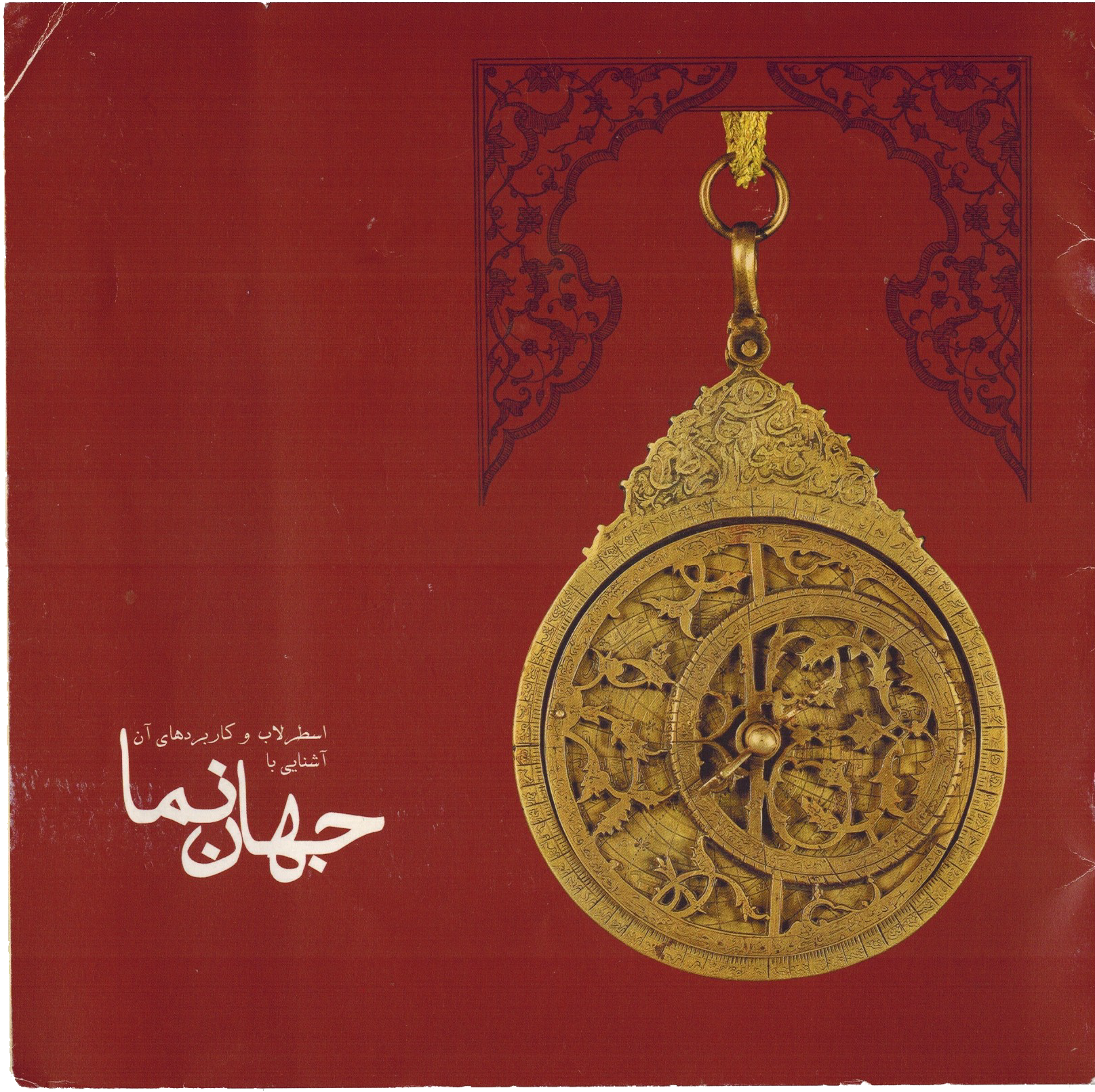
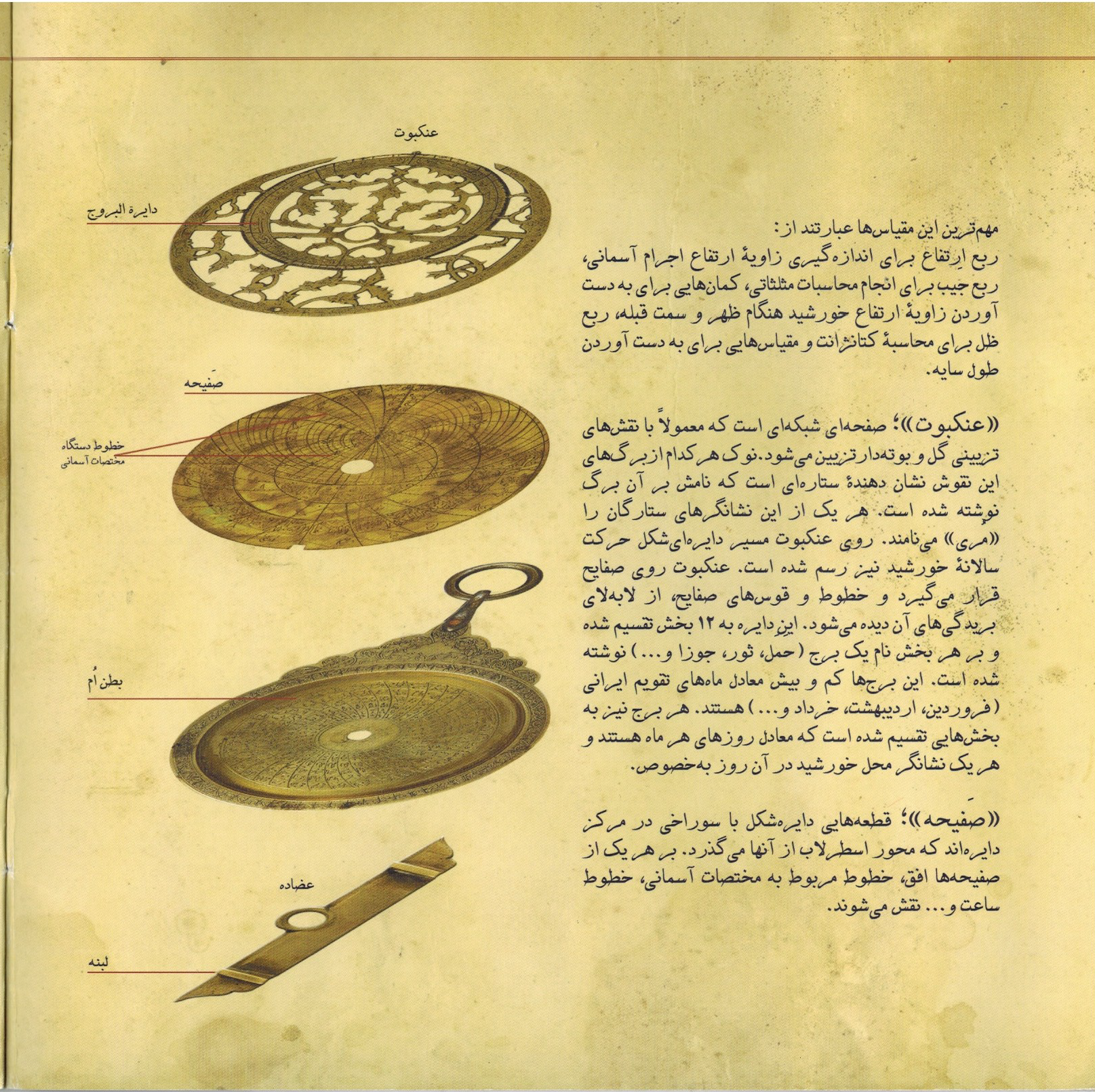
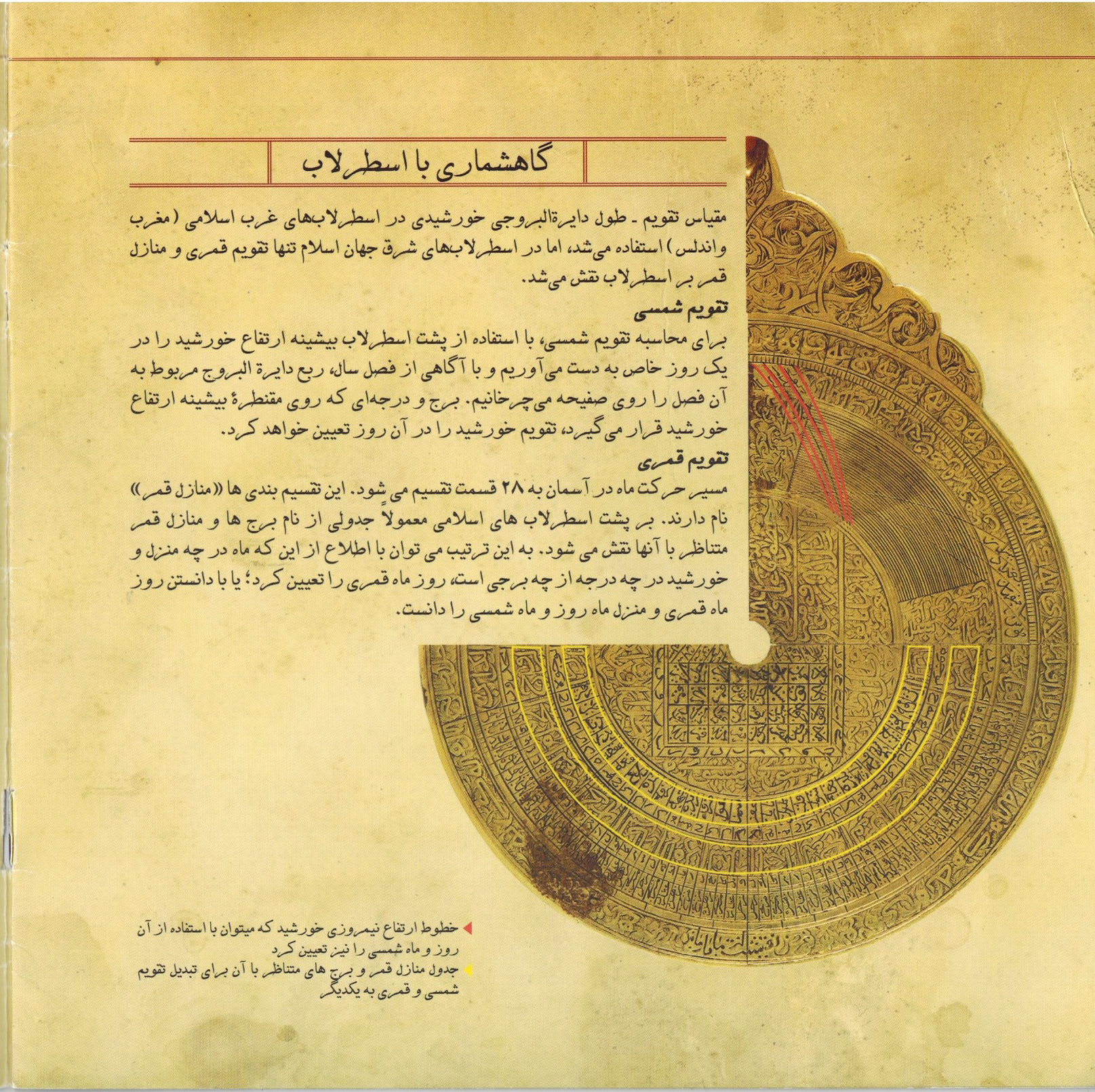
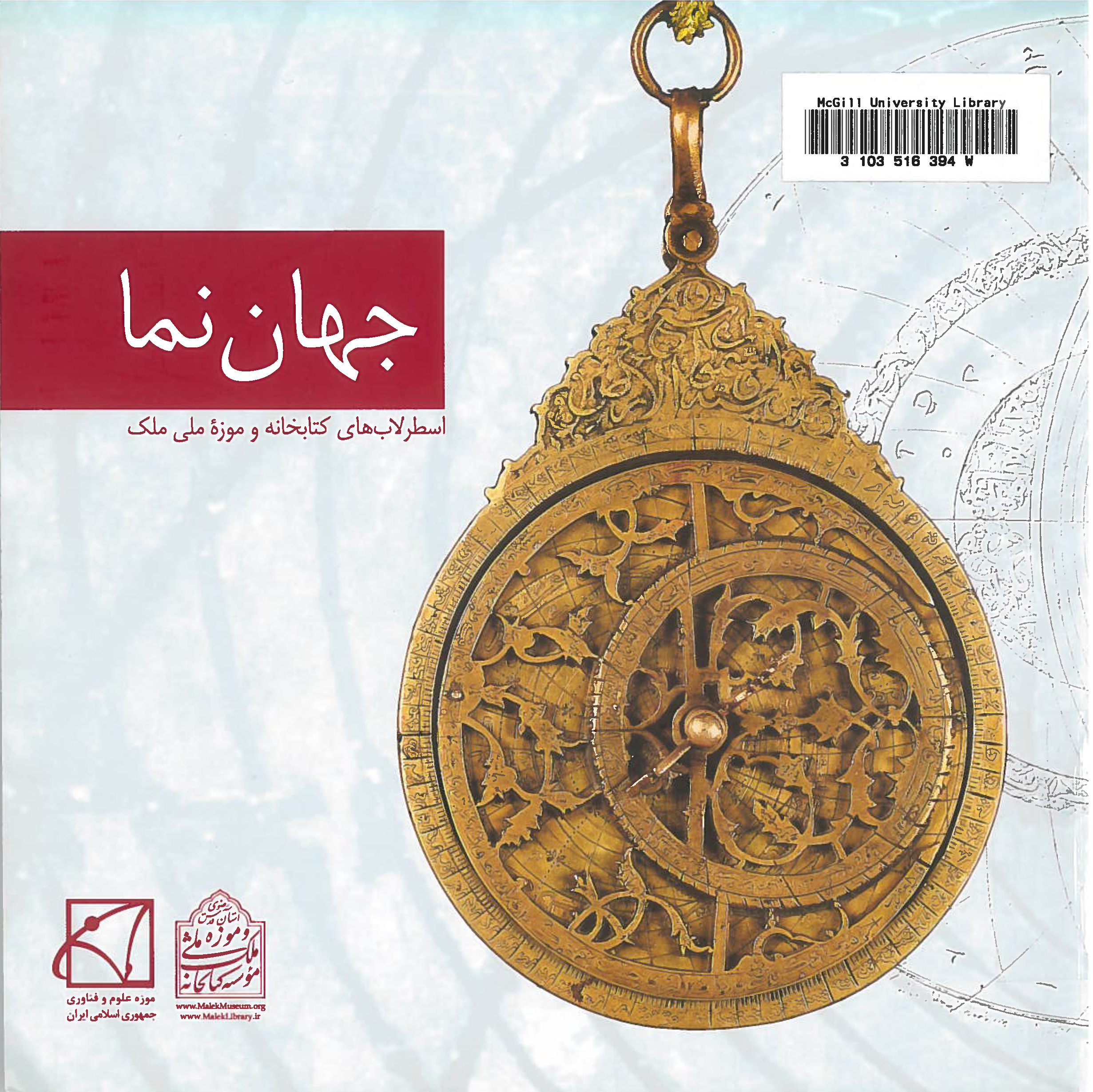
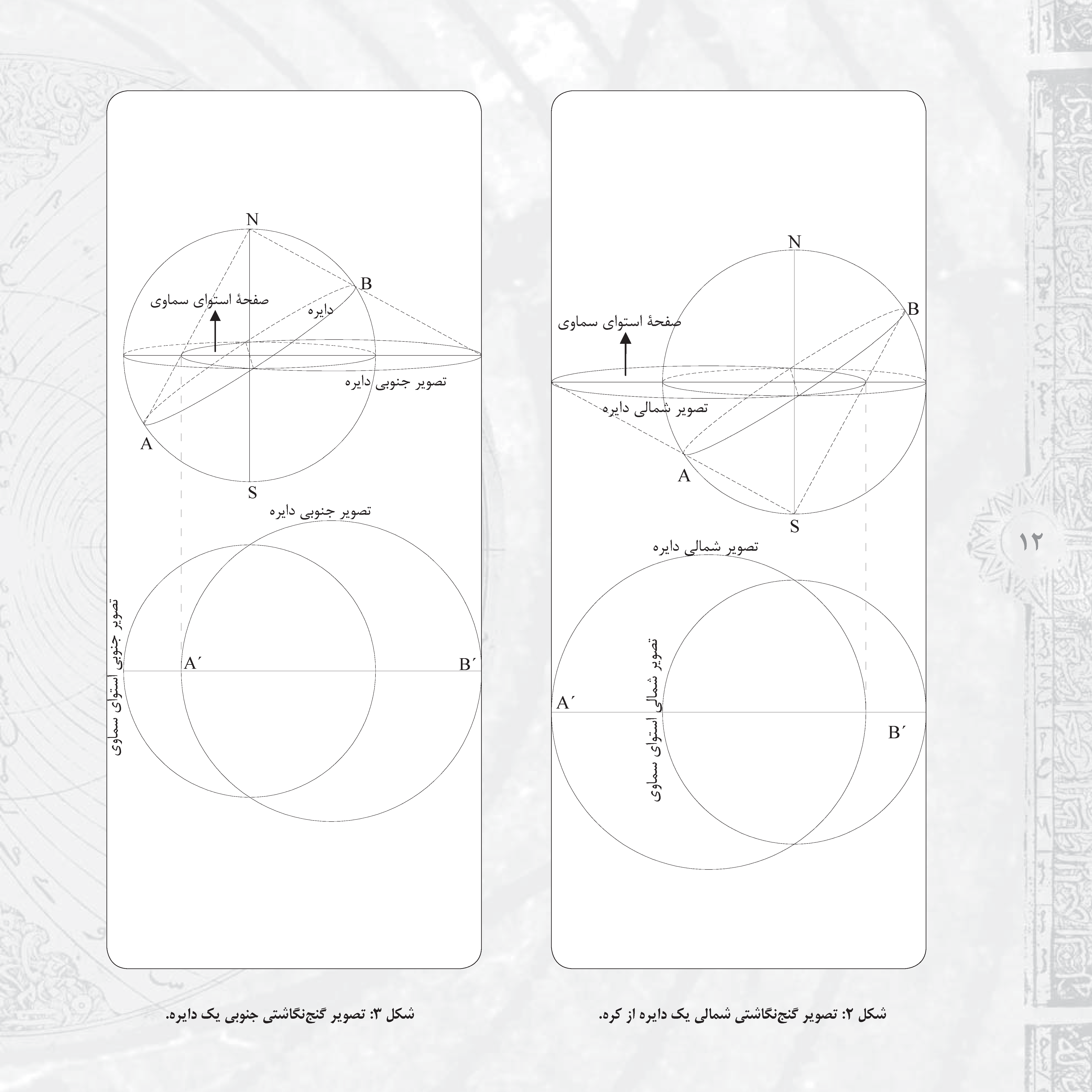
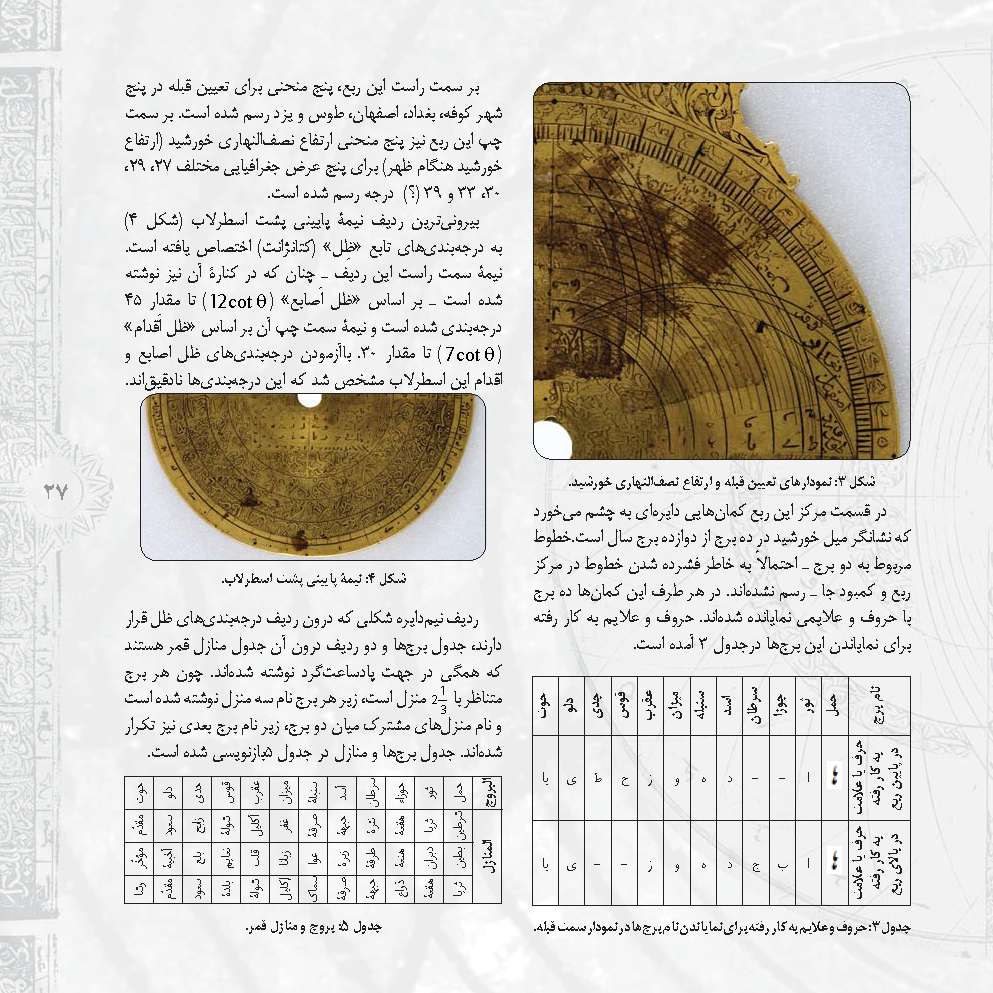
Cover and selected pages from the exhibition brochure (top) and the published catalogue (bottom).
The rete (star map) of an early 18th‑century astrolabe (2064) at the Malek Museum, superimposed with my digitally calculated and reconstructed rete for the same period. Set the video quality to HD (1080p) to see the reconstructed details clearly.