History of Science | Medieval Studies | Middle Eastern Studies | Intellectual, Digital and Spatial Histories
Bridging Disciplines: Research Scope and Approach
I study interdisciplinarity across mathematical sciences and natural philosophy alongside astronomical instrumentation, and computational methods in the Medieval Middle East and Central Asia. I have also conducted research on intellectual history and history of press in the 19th century Iran. In doing so, I analyze textual evidence preserved in Arabic, Persian, and Judeo-Persian manuscripts. Trained as a historian of medieval science with a background in geomatics engineering, I have practiced digital humanities (DH) for over a decade. My work integrates DH methods, including digital reconstruction of astronomical instruments and methods, mapping, and network analysis.
Explore the highlights of my research projects and discover how they bridge disciplines and methodologies.
Between Natural Philosophy and Mathematical Astronomy: Celestial Physics of Ibn Sīnā and its Interactions With Astronomy (2025)
My doctoral dissertation examines how Ibn Sīnā (Avicenna, the renowned 10th–11th century physician, Aristotelian philosopher, and polymath) negotiated interdisciplinary interactions between celestial natural philosophy (celestial physics) and mathematical astronomy. It offers a clear formulation of his celestial natural philosophy, showing how he sought to unify celestial and terrestrial physics by drawing on disciplines beyond physics. Finally, by analyzing points of tension between physics and astronomy, the study demonstrates Ibn Sīnā’s readiness to adapt astronomical theories in order to reconcile interdisciplinary disputes.
In this project, beyond traditional methodologies of close reading and analysis of historical texts, I also employ Geographic Information Systems (GIS) mapping as a digital humanities method. This approach allows me to explore Ibn Sīnā’s complex corpus, which challenged generations of disciples and bibliographers, since his works were produced in disarray and during his lifelong journey from Central Asia to Western Iran.
Ibn Sīnā (Avicenna) in Isfahan: A Geospatial Critique of his Imagined Past in the City (2024)
This project combines textual analysis and geospatial visualization of historical datasets to critically assess the claim that a medieval domed building in Isfahan—known as the Madras (teaching place) of Ibn Sīnā—was the site where Ibn Sīnā taught during his residence in the city in the early 11th century.
Revealing the latent mathematics in historical horoscopes (2019)
This project employs a digital reconstruction methodology to enable humanities researchers with little to no knowledge of mathematics to discover the underlying mathematical methods in historical horoscopes.
Demand and Advocacy for Modernization in the Nineteenth-Century Iran: The Reformist Thought of Mīrzā Maḥmūd Khān Afshār Kangāwarī in Context (2018)
Mīrzā Maḥmūd Khān Afshār Kangāwarī (ca. 1827-1895) was the second editor of Farhang, the first weekly newspaper in Isfahan (April 1879–April 1891). Modern scholarship recognizes him as a pioneering Iranian translator and journalist with modernist tendencies, yet little is known about his life, intellectual activities, and the context of his ideas. This project integrates oral family accounts with historical data dispersed across primary and secondary sources to construct a coherent bio bibliography and intellectual profile, situating Afshār within the shifting sociopolitical and religious context of his times.
A Judeo-Persian Commentary on Qūshjī’s Risālah dar ʿĪlm al-Hayʾa (Treatise on Physical Cosmography) (2018)
Hayʾa works form a branch of theoretical astronomy, comprising a “physical cosmography” built upon geometric mathematical models. One of the most widely used pedagogical Hayʾa works in Persian was authored by Alī b. Muḥammad Qūshjī, a 15th-century polymath. Among the multiple commentaries extant today on this work one is in Judeo-Persian, written or transcribed by Judah ben Eleazar (fl. 17th c. CE, Kashan, Iran), a Jewish physician and philosopher. This paper offers a codicological study of the Judeo-Persian manuscript, together with an analysis of its contents and of its scribal and linguistic characteristics, through the transliteration and translation of one chapter.
The explanation and the use of a natural phenomenon across disciplines: The moon-spots and the sciences in Islam (2017)
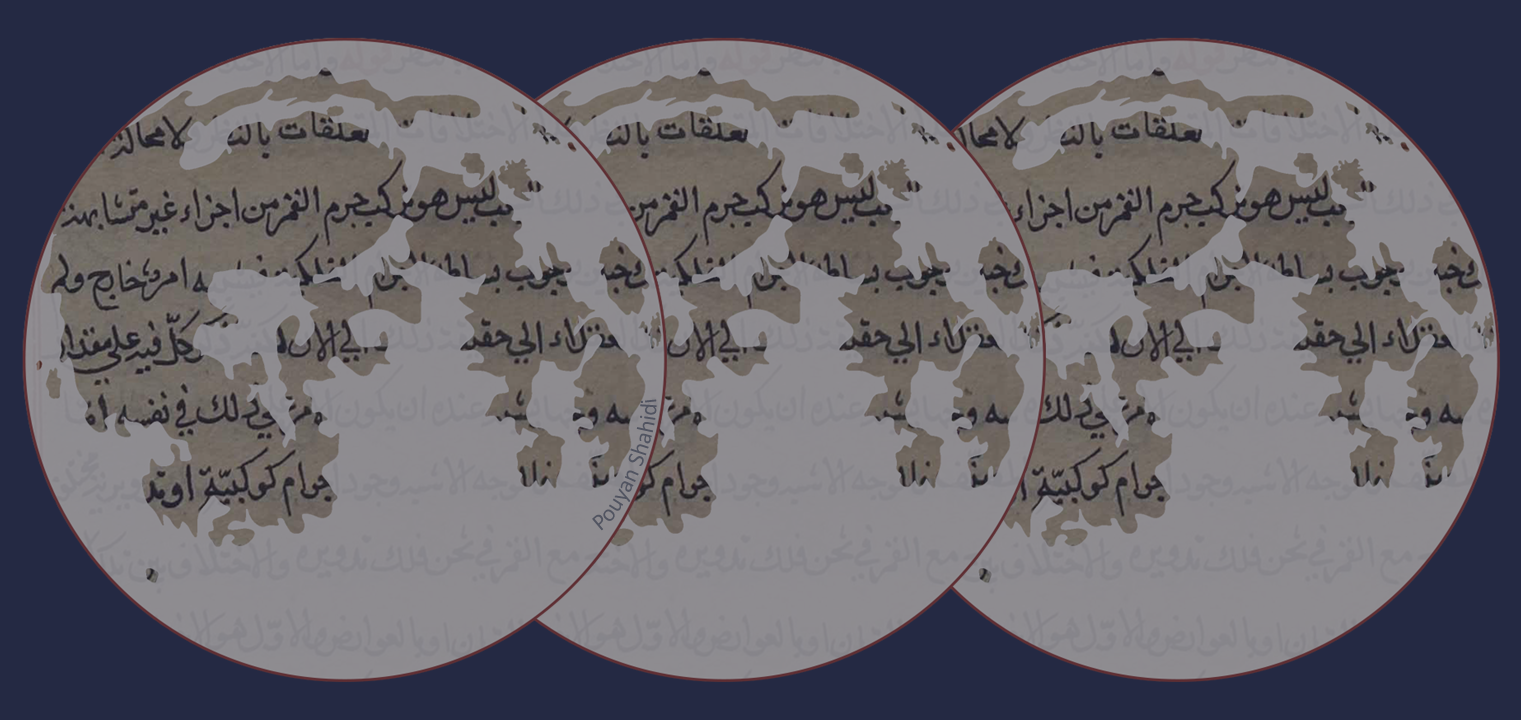
Premodern Islamic discussions of the nature of the spots on the moon (moon spots or lunar maria) lie at the intersection of multiple intellectual disciplines, including natural philosophy, mathematical astronomy, optics, Qurʾānic exegesis, and kalām (Islamic philosophical theology). This project demonstrates how these debates served different functions spanning from scientific explanation to maintaining theoretical coherence within individual disciplines, as well as debunking rival epistemologies. It further investigates whether and in what ways interdisciplinary coherence shaped the discussions of Ibn al-Haytham, Ibn Sīnā, al-Rāzī, and Quṭb al-Dīn Shīrāzī on the moon-spots across different disciplines.